
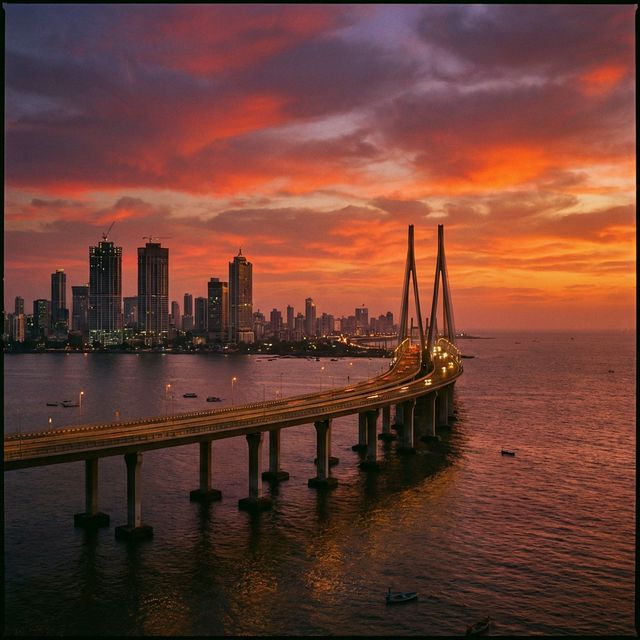
Mumbai Infrastructure &
Real Estate Outlook
How ₹5 lakh crore in metro, roads, airports, and ports is reshaping Mumbai's property landscape — and where to invest.

AI Travel Time Analysis: From BKC
How Mumbai's infrastructure revolution is cutting commute times from Bandra-Kurla Complex — the city's commercial nerve centre.
Infrastructure Project Dashboard
Track 15 major projects transforming Mumbai — from metro lines to airports.
The Infrastructure Revolution
Mumbai is undergoing one of the largest urban infrastructure transformations in the world — a multi-front overhaul spanning metro rail, expressways, coastal roads, sea links, and a brand new international airport.
Mumbai Metro: 14 Lines Reshaping the City
Mumbai's metro expansion is a network of 14 metro lines spanning over 340 km, designed to become the backbone of the city's transit system. From Colaba in the south to Thane in the north, from Andheri in the west to Mankhurd in the east, the metro will dramatically alter commuting patterns and, consequently, real estate values.
The Metro Line 3 (Colaba–Bandra–SEEPZ), India's first underground metro in Mumbai, is a game-changer. Running beneath the heart of the city, it connects Cuffe Parade, Churchgate, Mumbai Central, Worli, BKC, and the airport. This single line will cut commute times by 50–70% across some of Mumbai's most premium corridors.
Areas Impacted by Metro Expansion
Mumbai Coastal Road
The Mumbai Coastal Road is transforming the western seaboard of the city. Running from Marine Drive to the Bandra-Worli Sea Link, this 10.58 km stretch (with an 8-lane undersea tunnel) has already cut travel times from South Mumbai to Bandra from 60 minutes to under 20 minutes.
The project significantly boosts real estate values along the western corridor — particularly in Worli, Haji Ali, Breach Candy, and Bandra — by making South Mumbai more accessible while decongesting surface roads.
Coastal Road Beneficiaries
Mumbai Trans Harbour Link (MTHL / Atal Setu)
The 21.8 km MTHL — India's longest sea bridge — connects Sewri in South Mumbai to Chirle near Navi Mumbai. This has been a game-changer for Navi Mumbai real estate. What was once a 90-minute commute from Navi Mumbai to South Mumbai is now a 20-minute drive.
The MTHL has directly boosted property demand in Ulwe, Panvel, Kharghar, and Vashi, making them viable alternatives to Mumbai proper for executives working in BKC, Lower Parel, and SoBo.
MTHL Impact Zone
Mumbai–Ahmedabad High-Speed Rail (Bullet Train)
India's first bullet train corridor will connect BKC (Mumbai) to Ahmedabad in just 2 hours, with intermediate stops at Thane and Virar. The BKC terminal will further cement the area's status as Mumbai's most connected commercial hub, attracting multinational tenants and driving premium office rents.
Navi Mumbai International Airport (NMIA)
The upcoming Navi Mumbai International Airport at Ulwe will be a catalyst for the entire eastern corridor. Expected to handle 20 million passengers annually in Phase 1, the airport will transform areas like Ulwe, Panvel, Dronagiri, and Kharghar into high-demand zones for both residential and commercial properties. Airport-adjacent locations historically see 30–50% property value appreciation.
Expressway Network
The Mumbai–Nagpur Samruddhi Expressway (701 km) connects Maharashtra's two largest cities in under 7 hours. Combined with the Mumbai–Pune Expressway and the Virar–Alibaug Multimodal Corridor, these expressways are creating new growth corridors and unlocking dormant real estate potential in Igatpuri, Nashik, and the Konkan belt.
Game-Changing Connectivity Projects
Three projects that will reshape how Mumbai's western and eastern suburbs interact — and where people choose to live.
Borivali–Thane Tunnel
This tunnel will provide a direct, uninterrupted route between Borivali and Thane, bypassing the congested Western Express Highway. It will make eastern suburbs accessible from the west in under 15 minutes, transforming commuter patterns.
Goregaon–Mulund Link Road
This critical east-west connector will ease congestion on the Eastern Express Highway and create a direct route between two of Mumbai's largest residential suburbs — driving demand in both Goregaon and Mulund.
Airoli Bridge: East-West Integration
The Airoli Bridge will create a direct, seamless link between the Eastern and Western Suburbs, bypassing congestion on existing routes. Residents of Kalyan, Dombivli, and Thane will have dramatically reduced commute times to South Mumbai and BKC.
Mira–Bhayandar Metro Extension
Metro Line 9 extends from Dahisar East to Mira Road and Bhayandar, providing a parallel, high-capacity transit option. These far-northern suburbs will shift from pure residential zones to mixed-use neighborhoods with better connectivity to BKC and Lower Parel.
Connectivity Beneficiaries
The Future: Mumbai 2030 and Beyond
The future of Mumbai is not just about more infrastructure — it's about smarter, greener, and more inclusive infrastructure.
The 45–60 Minute City Vision
With the Metro, MTHL, Coastal Road, and expressways converging, Mumbai is set to become a 45–60 minute city. Most key corridors — Thane to BKC, Navi Mumbai to Lower Parel, Borivali to BKC — will be accessible within 45 to 60 minutes.
This transforms commuter behavior: the current three or four-tier connectivity (buses, taxis, autos, ride-shares) will streamline to a two-tier system — a short ride to the nearest metro station, then metro to your destination. This makes the entire MMR region viable for executive-level living.
Areas that were "too far" — Thane, Navi Mumbai, Goregaon — become 30–45 minute commutes to major offices. This means premium apartments at 30–50% lower rents compared to Bandra or Worli.
Satellite Cities & Housing Expansion
Growth is being channelled into satellite cities like Palghar, Panvel, Vasai-Virar, and Ulwe. These are slated to become new economic clusters with robust infrastructure, affordable housing, and greenfield development. Areas like Dombivli and Kalyan are seeing rapid growth due to improved connectivity from the Airoli Bridge and MTHL.
Emerging Growth Hubs
Digital & Green Infrastructure
Mumbai is embracing futuristic urban living where technology and sustainability create a more efficient, environmentally friendly city.
AI Traffic Management
Real-time data analysis, quicker response times, and smarter commutes across the city.
Waste-to-Energy
Converting waste into energy, reducing landfill reliance, and contributing to cleaner solutions.
Solar Rooftops
Mandated solar systems on commercial and residential buildings for sustainable energy.
EV Charging
Strategic charging stations across the city encouraging eco-friendly transport adoption.
Smart Governance
Digital platforms for seamless citizen services, greater transparency, and faster delivery.
Redevelopment & Urban Renewal
Thousands of old buildings, cessed properties, and chawls are being transformed into modern, high-rise structures.
Mumbai's redevelopment drive is not just cosmetic. Thousands of old buildings, cessed properties, and chawls are being redeveloped into newer, taller, and more spacious structures. Long-standing residents are being relocated to larger homes with better amenities.
The financial impact is substantial: new developments drive up property values, increase stamp duty collections, and generate recurring property tax revenue. The construction boom also creates employment and boosts consumer spending.
Revised Floor Space Index (FSI) norms allow taller, more efficient buildings. The government also incentivizes green buildings with extra FSI for sustainable projects. This is transforming neighborhoods like Prabhadevi, Lower Parel, Dadar, and Byculla from aging to premium.
Real Estate & Policy Outlook
How government policy reforms and commercial real estate trends are shaping Mumbai's property landscape.
The Rise of Commercial Real Estate
The CRE sector is experiencing rapid expansion. Demand for office spaces has surged as businesses in IT, finance, and technology continue to grow. Areas like BKC, Nariman Point, and Lower Parel have witnessed skyrocketing rental yields.
But the demand is no longer confined to CBDs. Suburban and peripheral areas are seeing an uptick in commercial activity — Thane, Airoli, and Borivali are emerging as key commercial hotspots as companies move to reduce overhead costs while benefiting from larger spaces.
Specialized facilities — industrial parks, logistics hubs, and data centres — are also in high demand, driven by e-commerce, cloud computing, and big data growth.
Affordable Housing Initiatives
Affordable housing remains a priority, with the government working through public-private partnerships (PPPs). This is particularly focused on expanding suburban areas like Thane, Navi Mumbai, and Goregaon, where mixed-use developments are gaining momentum.
Commercial RE Hotspots
Port Infrastructure & Maritime Hub
Mumbai's maritime legacy meets its modern future with world-class cruise and cargo infrastructure.
Mumbai International Cruise Terminal (MICT)
April 2025 marked a milestone with the commencement of operations at the Mumbai International Cruise Terminal at Ballard Pier — India's largest cruise terminal, designed to handle up to 1 million passengers annually (approximately 10,000 per day).
Spread across 4.15 lakh square feet, the MICT was developed as per global standards under the Cruise Bharat Mission. Its launch not only strengthens Mumbai's position as a global maritime hub but also unlocks opportunities for heritage tourism, urban renewal in South Mumbai, and economic revival of adjacent areas.
Port-Adjacent Real Estate
Mumbai's Time Is Now
The story of Mumbai has always been one of transformation. Today, we stand at the dawn of a new chapter — a chapter where infrastructure will elevate the city into the ranks of global megacities like Singapore, London, and New York.
The groundwork is already laid. From sea links and metros to airports and smart grids, Mumbai is shedding its past challenges and embracing a future where time is optimised, business is frictionless, and quality of life is dramatically improved.
As we move towards 2030, Mumbai isn't just building bridges and roads — it is building the future of India.
About the Author
Sandeep Sadh is a Mumbai-based real estate advisor with 33 years of experience in the city's evolving property landscape. He contributes regularly to industry publications and government think tanks on urban development and investment strategies.
Find Properties in Mumbai's High-Growth Zones
Use our area guide and relocation planner to find the best neighborhoods for your budget and lifestyle.